
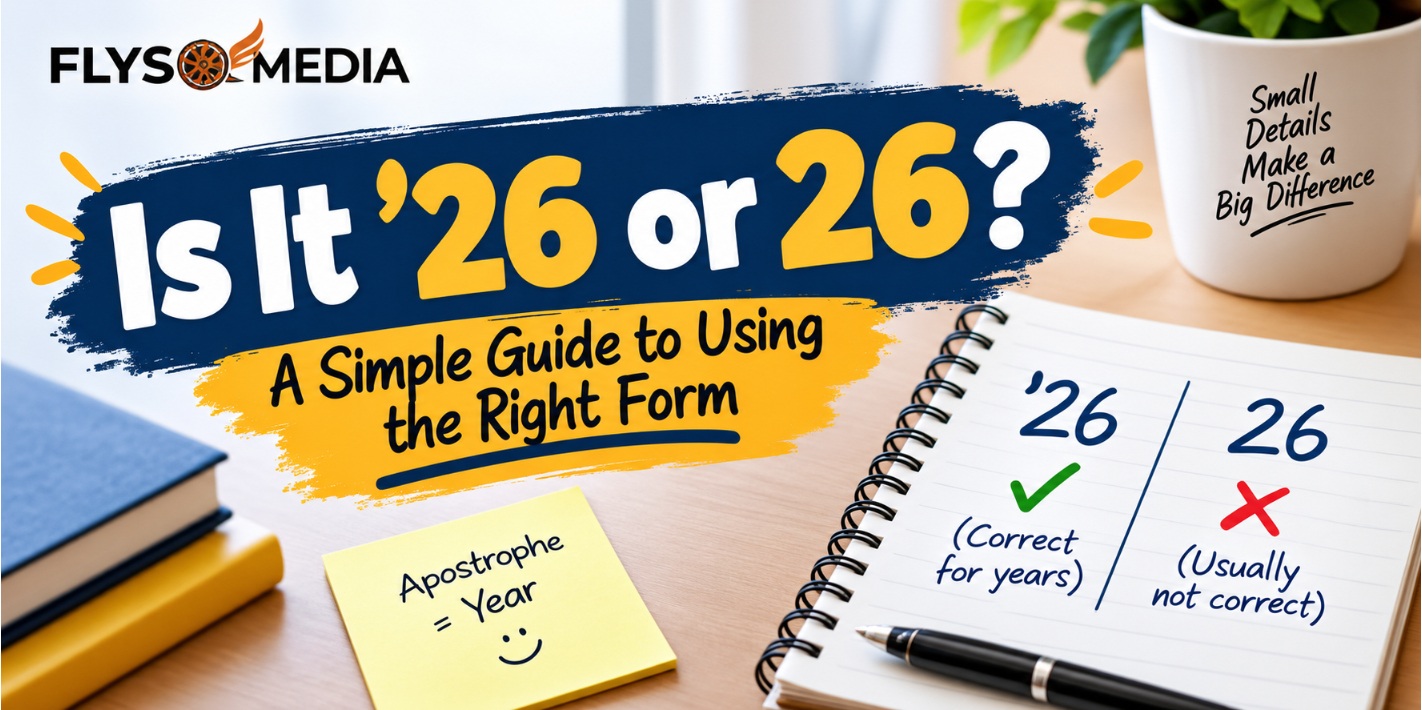
A small punctuation mark can completely change the meaning of a number. This is especially true when writing 26 and ’26. Although the two forms look almost the same, they serve different purposes.
- 26 vs. ’26: What Is the Difference?
- Why Does ’26 Have an Apostrophe?
- When Should You Write 26?
- When Should You Use ’26?
- The Key Question: Is It a Number or a Year?
- Full Year vs. Shortened Year
- Common Errors With 26 and ’26
- 1. Adding an Apostrophe to an Ordinary Number
- 2. Abbreviating a Year When Clarity Is Important
- 3. Treating the Apostrophe as Decoration
- 4. Forgetting About Context
- Examples in Different Situations
- Talking About Age
- Talking About a Calendar Year
- Graduation or Class References
- Marketing and Fashion
- Professional and Academic Content
- When Is It Better to Avoid ’26?
- A Three-Step Test
- Step 1: Is it a normal number?
- Step 2: Is it referring to a year?
- Step 3: Could the abbreviation cause confusion?
- Tips for Better Use of Abbreviated Years
- Quick Comparison
- Key Takeaways
- FAQ
- Is ’26 correct when talking about someone’s age?
- Can ’26 refer to different years?
- Is ’26 grammatically acceptable?
- Should I use ’26 in formal writing?
- Why do schools use “Class of ’26”?
- Is 2026 better than ’26 for SEO content?
- Conclusion
26 is an ordinary number, while ’26 is generally an abbreviated way of writing a year, such as 2026 or 1926. The apostrophe indicates that part of the year has been omitted.
Understanding this distinction makes it much easier to decide which version belongs in a sentence, headline, school reference, marketing campaign, or professional document.
26 vs. ’26: What Is the Difference?
The basic difference is straightforward:
- 26 = the number twenty-six
- ’26 = a shortened year, such as 2026 or 1926
For example:
- She is 26 years old.
- The university welcomed the Class of ’26.
- We purchased 26 tickets.
- The company plans to expand in ’26.
In the first and third examples, 26 is simply a number. In the second and fourth, ’26 refers to a year with the first part omitted.
The apostrophe is therefore meaningful rather than decorative.
Why Does ’26 Have an Apostrophe?
The apostrophe indicates that characters have been left out. In a shortened year, the first two digits are usually removed.



For example:
2026 → ’26
The same shortened form could potentially represent:
1926 → ’26
This is similar to the way an apostrophe indicates omitted letters in contractions such as:
- do not → don’t
- I am → I’m
The purpose is to show that something has been omitted.
For general information about apostrophe usage and punctuation, you can also refer to the Wikipedia page on the apostrophe.
When Should You Write 26?
Use 26 when you are referring to an ordinary number rather than an abbreviated year.
This includes situations involving:
- Age
- Quantity
- Measurements
- Prices
- Rankings
- Counts
- Distances
- Other numerical values
Examples
- My brother is 26 years old.
- We sold 26 products today.
- The building has 26 floors.
- The package weighs 26 kilograms.
- She finished in position 26.
- The book contains 26 chapters.
There is no missing information in these examples. The number is being used exactly as a number, so an apostrophe is unnecessary.
An Easy Rule to Remember
If 26 can be understood as “twenty-six” without referring to a particular year, leave the apostrophe out.
For example:
26 students
26 years old
26 pages
All of these use the standard number.
When Should You Use ’26?
Use ’26 when you are intentionally shortening a year.
This form is especially common when the context already makes the intended year obvious.
For example:
- Class of ’26
- Spring ’26 Collection
- Our ’26 Goals
- The campaign launches in ’26
- Welcome to the Class of ’26
You will often encounter this style in school and graduation materials, advertising, fashion, event names, social media, and other informal or creative content.
The shortened version can make a headline or design more compact, but the surrounding context should make the year clear.
The Key Question: Is It a Number or a Year?
When you are uncertain, ask yourself what 26 actually represents.
If it represents:
- Someone’s age
- A quantity
- A measurement
- A ranking
- A count
- A price or other numerical value
use 26.
If it represents:
- A calendar year
- A graduation year
- A year associated with an event
- A product or fashion collection tied to a year
- A shortened reference to a past or future year
then ’26 may be appropriate.
This simple distinction resolves most cases.
Full Year vs. Shortened Year
There is another choice to consider: even when you are talking about a year, do you actually need to abbreviate it?
For many types of writing, the full year is preferable.
Formal Writing
In academic papers, business reports, official documents, research material, and other formal writing, using the complete year usually provides greater clarity.
For example:
- The project will begin in 2026.
- The records were created in 1926.
- The conference is scheduled for 2026.
These versions leave little room for uncertainty.
Writing ’26 may force readers to determine which century you mean, particularly when the wider context does not make it obvious.
Informal and Creative Writing
The shortened form is more common in casual or visual content.
Examples include:
- Can’t wait for ’26!
- Welcome, Class of ’26
- Fall ’26 Collection
- Our plans for ’26
In these situations, the abbreviated year can fit naturally into a headline, graphic, caption, or branding concept.
Common Errors With 26 and ’26
Because the forms are visually similar, writers sometimes use them interchangeably. Here are some common mistakes to avoid.
1. Adding an Apostrophe to an Ordinary Number
Incorrect: She bought ’26 books.
Correct: She bought 26 books.
The sentence describes a quantity, not a year.
2. Abbreviating a Year When Clarity Is Important
Less clear: The company expects significant growth in ’26.
Clearer: The company expects significant growth in 2026.
The abbreviated version isn’t necessarily wrong, but the full year may communicate the information more clearly.
3. Treating the Apostrophe as Decoration
An apostrophe should have a purpose. It indicates omitted characters in a shortened year.
Adding one simply because it makes a design or headline look more stylish can create an error.
4. Forgetting About Context
The expression ’26 does not identify a century by itself.
Depending on the context, it could refer to 1926, 2026, or another year ending in 26. That’s why context is important.
Examples in Different Situations
Seeing the distinction across different situations can make the rule easier to remember.
Talking About Age
Use the regular number:
- He turned 26 this year.
- She is 26 years old.
Talking About a Calendar Year
Use the full year when clarity is important:
- The new office opens in 2026.
- The records date back to 1926.
Graduation or Class References
A shortened year is common:
- Class of ’26
- The Class of ’26 will graduate in May.
Marketing and Fashion
Creative industries often shorten years:
- Spring ’26 Collection
- Fall ’26 Preview
- Summer ’26 Campaign
Professional and Academic Content
The complete year is generally easier to understand:
- The research was published in 2026.
- The archive contains documents from 1926.
When Is It Better to Avoid ’26?
There are several situations where spelling out the complete year is the safer choice.
Consider using 2026 instead of ’26 when:
- You are writing an academic paper.
- You are preparing a business report.
- You are creating a legal or official document.
- Your international audience may not understand the context.
- The century is uncertain.
- The sentence could be interpreted in multiple ways.
- Accuracy and clarity are more important than visual style.
For example, a formal report is generally clearer when it says:
The policy will become effective in 2026.
rather than:
The policy will become effective in ’26.
A Three-Step Test
Still unsure whether to write 26 or ’26? Use this quick test.
Step 1: Is it a normal number?
If you are talking about age, quantity, measurement, or counting, use 26.
Step 2: Is it referring to a year?
If yes, decide whether the full year or abbreviated version is more appropriate.
Step 3: Could the abbreviation cause confusion?
If there is any realistic possibility of confusion, write the complete year.
This approach works for most everyday writing situations.
Tips for Better Use of Abbreviated Years
Think About Your Audience
Different audiences expect different writing styles. A graduation poster may naturally use ’26, while an academic report may benefit from 2026.
Put Clarity First
Shortened years can look clean and modern, but visual appeal should not make the meaning harder to understand.
Stay Consistent
If you decide to use abbreviated years in a campaign or design project, follow the same style throughout the material.
Don’t Add Apostrophes Without a Reason
Remember that the apostrophe represents something that has been omitted. If you are simply writing the number twenty-six, there is nothing to omit.
Quick Comparison
| Form | Meaning | Example |
|---|---|---|
| 26 | Regular number | She is 26 years old. |
| ’26 | Abbreviated year | Class of ’26 |
| 2026 | Full year | The event takes place in 2026. |
| 1926 | Full historical year | The document dates from 1926. |
This comparison highlights why choosing between 26 and ’26 depends on the role the number plays in the sentence.
Key Takeaways
The main rule is simple:
- 26 is an ordinary number.
- ’26 is normally a shortened form of a year.
- The apostrophe indicates that part of the year has been omitted.
- Age and quantity should normally be written as 26, not ’26.
- ’26 is common in graduation references, branding, marketing, and casual writing.
- Full years such as 2026 are often clearer in formal and professional writing.
- If the shortened form could create confusion, use the complete year.
FAQ
Is ’26 correct when talking about someone’s age?
No. When referring to age, use 26 without an apostrophe. For example, “She is 26 years old.”
Can ’26 refer to different years?
Yes. Depending on the context, ’26 could represent years such as 1926 or 2026. The surrounding information determines the intended meaning.
Is ’26 grammatically acceptable?
Yes, when it is being used as an abbreviation for a year. It should not be used as a replacement for the ordinary number 26.
Should I use ’26 in formal writing?
Usually, writing the complete year is clearer in formal, academic, legal, and professional contexts. The full year removes possible ambiguity.
Why do schools use “Class of ’26”?
It is a concise way to identify a graduating class by its year. Since the context is usually obvious, the shortened form is widely understood.
Is 2026 better than ’26 for SEO content?
In many informational and professional articles, 2026 is preferable because it is more explicit and avoids ambiguity. However, the best choice ultimately depends on the context and intended meaning.
Conclusion
The difference between 26 and ’26 comes down to what the number represents. 26 is a regular numeral used for age, quantity, measurements, and other numerical values. ’26, on the other hand, is a shortened reference to a year, with the apostrophe showing that part of the year has been removed.
For formal, academic, and professional writing, using the complete year—such as 2026—often provides the clearest meaning. In graduation materials, marketing, social media, branding, and other creative settings, ’26 can be a natural shorthand.
When in doubt, focus on one question: Am I writing a number, or am I referring to a year? That answer will usually tell you which form to choose.
For More Information Visit: https://flysmedia.co.uk/