
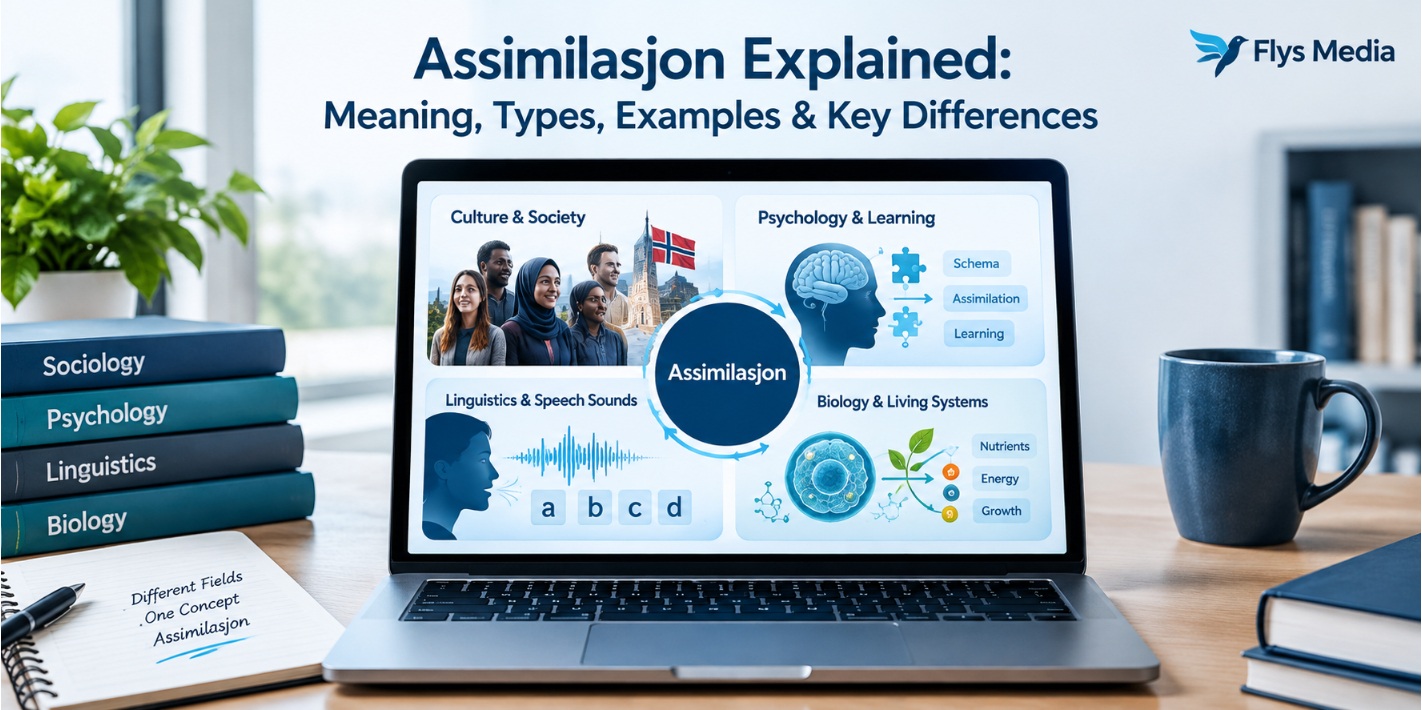
Assimilasjon is the Norwegian word for assimilation. It describes a process where something new enters an existing system and becomes part of it. The system can be a culture, a person’s mind, spoken language, or a living organism.
- What Does Assimilasjon Mean?
- Assimilasjon in Sociology
- Cultural and Structural Assimilation
- Voluntary and Forced Assimilation
- Assimilation vs Integration vs Multiculturalism
- Assimilasjon in Psychology
- Assimilation and Accommodation
- Assimilasjon in Linguistics
- Progressive and Regressive Assimilation
- Assimilasjon in Biology
- Carbon Assimilation in Plants
- Everyday Examples of Assimilation
- Why Is Assimilasjon Important?
The exact meaning depends on the subject. In sociology, it can describe how people adopt features of another culture. In psychology, it explains how new information is connected to existing ideas. In linguistics, it describes nearby sounds becoming more similar. In biology, it refers to how nutrients are changed and incorporated into living material.
What Does Assimilasjon Mean?
In simple terms, Assimilasjon means making something fit into an existing structure. An outside element is received, processed, and gradually made similar to what is already there.
The amount of change can vary. Sometimes the new element changes only slightly. In other situations, its original characteristics may become difficult to recognize.
This broad idea is why the word appears across different academic fields. Sociology, psychology, linguistics, and biology study very different systems, but each uses the same basic pattern: something enters a system and becomes part of it.
The Norwegian term is related to the same Latin origin as the English word “assimilation.” Depending on the context, it can describe social behavior, learning, speech sounds, or biological processes. For a general overview of these meanings, see Wikipedia: Assimilation.
Assimilasjon in Sociology
In sociology, assimilation describes a process in which a person or group adopts important features of a larger or dominant society. These features can include language, clothing, food, values, traditions, behavior, and everyday social practices.
The process may begin with ordinary interaction. New residents learn how schools, workplaces, government offices, and public services operate. Learning the main language can also make it easier to study, work, communicate, and build relationships.



Complete assimilation goes further. A minority group may gradually become less distinguishable from the majority in public life. Some traditional customs may decline, while others can continue within families or private communities.
Assimilation should also be separated from integration. Integration allows people to participate in wider society while maintaining more elements of their original cultural identity.
Cultural and Structural Assimilation
Cultural change often develops through everyday experiences. People may learn the language, manners, customs, social expectations, and common practices of the society around them. This is closely connected with the idea of acculturation.
Structural change occurs when people become involved in major institutions. Schools, universities, workplaces, professional organizations, political groups, and community organizations can all play a role.
Participation in these institutions can influence employment, income, social status, and a person’s sense of belonging.
Assimilation does not always happen in every area of life. Someone might use the dominant language at work but speak another language with family members. A household may follow local laws while continuing its traditional food, names, celebrations, beliefs, or family practices.
As a result, cultural adaptation can be uneven. People may adopt some new habits while deliberately keeping older traditions.
Voluntary and Forced Assimilation
Assimilation can happen through personal choice. For example, an immigrant may learn a new language to find employment, communicate with neighbors, or help children succeed at school. These changes can make everyday communication and participation easier.
History also contains examples of forced assimilation. Governments and colonial authorities have sometimes attempted to replace minority languages, names, clothing, beliefs, traditions, and family practices.
Such policies have particularly affected Indigenous communities and other groups with limited political power. Forced assimilation can damage cultural continuity by interrupting the transfer of language and traditions from parents to children.
It can also create lasting distrust toward public institutions. The major distinction is consent. Adaptation chosen for practical or personal reasons is different from cultural change imposed through pressure, punishment, exclusion, or government policy.
Assimilation vs Integration vs Multiculturalism
Assimilation, integration, and multiculturalism describe different approaches to cultural diversity.
Assimilation generally involves minority groups becoming more similar to the dominant culture. Integration allows people to participate in shared social institutions while retaining parts of their original identity.
Multiculturalism, by contrast, recognizes cultural differences as an ongoing feature of society. Different languages, traditions, and identities can exist together within the same country or community.
The “melting pot” idea is often associated with assimilation because different cultural groups gradually blend into a shared form. The “salad bowl” comparison is more closely connected with multiculturalism because different cultural elements remain visible while existing together.
Real societies are rarely based on only one model. People can share laws, schools, workplaces, and public institutions while maintaining different foods, languages, celebrations, beliefs, and family traditions.
Assimilasjon in Psychology
In psychology, Jean Piaget used assimilation as part of his explanation of cognitive development. People create mental structures called schemas that help them organize and understand experiences.
When new information fits an existing schema, a person can add that information without completely changing the mental structure.
For example, a child may learn that a small animal with four legs and fur is a dog. Later, the child sees a different breed of dog and recognizes it using the same basic mental category.
This makes learning more efficient. The mind does not need to create a completely new category for every minor difference.
However, existing ideas can sometimes cause mistakes. A person may try to fit unfamiliar information into an old belief even when the connection is not accurate.
Assimilation and Accommodation
Assimilation is one part of Piaget’s theory of adaptation. The other important process is accommodation.
Accommodation occurs when a person changes an existing schema or develops a new one because the old mental structure does not properly explain new information.
Imagine a child who sees a cat for the first time and calls it a dog. The child notices similarities such as four legs, fur, and a tail. At first, the existing “dog” category is used. Later, after learning more, the child creates a separate category for cats.
Both processes are important for learning. Assimilation connects new experiences with existing knowledge, while accommodation improves understanding when old ideas are not sufficient.
Together, they allow people to learn continuously without having to rebuild their entire understanding of the world whenever they encounter something new.
Assimilasjon in Linguistics
In linguistics, assimilation occurs when one speech sound becomes more similar to a nearby sound. It is especially common during quick or natural speech.
This change can make pronunciation easier because the tongue, lips, and vocal system do not have to move as dramatically between sounds.
For instance, some speakers pronounce “handbag” in a way that sounds closer to “hambag.” The upcoming “b” sound influences the pronunciation of the preceding “n,” causing it to move toward an “m” sound.
These changes are normal parts of connected speech. Linguists examine them to understand pronunciation patterns, accents, and how languages develop over time.
Progressive and Regressive Assimilation
Sound assimilation can occur in different directions.
Regressive assimilation happens when a later sound influences the sound that comes before it. It is sometimes called anticipatory assimilation because the speaker prepares for an upcoming sound.
Progressive assimilation works in the opposite direction, with an earlier sound influencing a following sound.
English plural endings provide a simple example. The ending in “cats” is pronounced without voicing after the unvoiced “t,” while the ending in “dogs” is voiced after the voiced “g.”
Assimilation can involve the place of articulation, voicing, or manner of pronunciation. It can also be complete or partial.
These patterns help explain why spoken language can sound different from its written form, particularly during fast and informal conversations.
Assimilasjon in Biology
In biology, assimilation is connected with metabolism. Organisms take in external substances and transform them into materials that cells can use.
During digestion, food is broken into smaller components. Proteins are reduced to amino acids, fats provide fatty acids and glycerol, and carbohydrates are converted into simple sugars such as glucose.
After absorption, cells can use these nutrients for growth, tissue repair, energy storage, and normal body functions. The substances no longer remain exactly as they were in the original food.
This makes biological assimilation different from digestion. Digestion breaks food into usable components, while assimilation involves incorporating those absorbed materials into the organism.
Carbon Assimilation in Plants
Plants carry out an important form of assimilation through photosynthesis. They take carbon dioxide from the atmosphere and water from the environment, then use light energy to produce organic compounds.
One major product is glucose, which can support energy needs and plant growth. Plants can also use carbon-based compounds to form substances such as cellulose and starch.
Carbon assimilation is important throughout food chains. Animals obtain carbon by eating plants or consuming other organisms that depend on plants.
The key idea is that carbon dioxide does not simply remain outside the plant. It is chemically transformed and incorporated into organic material that becomes part of living tissue.
Everyday Examples of Assimilation
Assimilation may seem like a technical concept, but it appears in ordinary situations.
A new employee may learn the communication style and routines of a workplace. A child may use an existing mental category to understand an unfamiliar animal.
A speaker may change one sound while talking quickly because another sound follows it. Inside the body, cells transform nutrients from a meal into materials needed for energy, maintenance, and growth.
These examples involve very different systems, but the basic process is similar. Something comes from outside, enters a system, and is changed or organized so that it can become part of that system.
The result is not always complete transformation. Some original features may remain, while others can gradually blend into the surrounding structure.
Why Is Assimilasjon Important?
Assimilasjon connects several fields through one central idea: a system receives something new and incorporates it into what already exists.
In sociology, it can involve culture, identity, belonging, power, and personal choice. In psychology, it helps explain how existing knowledge influences the way people understand new experiences. In linguistics, it shows how speech sounds naturally adjust to one another. In biology, it describes how external nutrients and materials become part of living systems.
The word must therefore be understood according to its context. Social assimilation can involve important questions about culture and consent, while linguistic assimilation is a normal feature of spoken language. Biological assimilation is essential to life, and cognitive assimilation contributes to learning.
Understanding these different meanings makes the term easier to use correctly. It also shows how a single concept can connect society, human thought, language, and biology.